
Technology
Water goes to the roots, the lawn stays dry
Under the lawn we lay Rain Bird XFS dripline in a grid. Here you will find how it works, the data sheet figures and how we work on site.
Under the lawn
What happens under the lawn
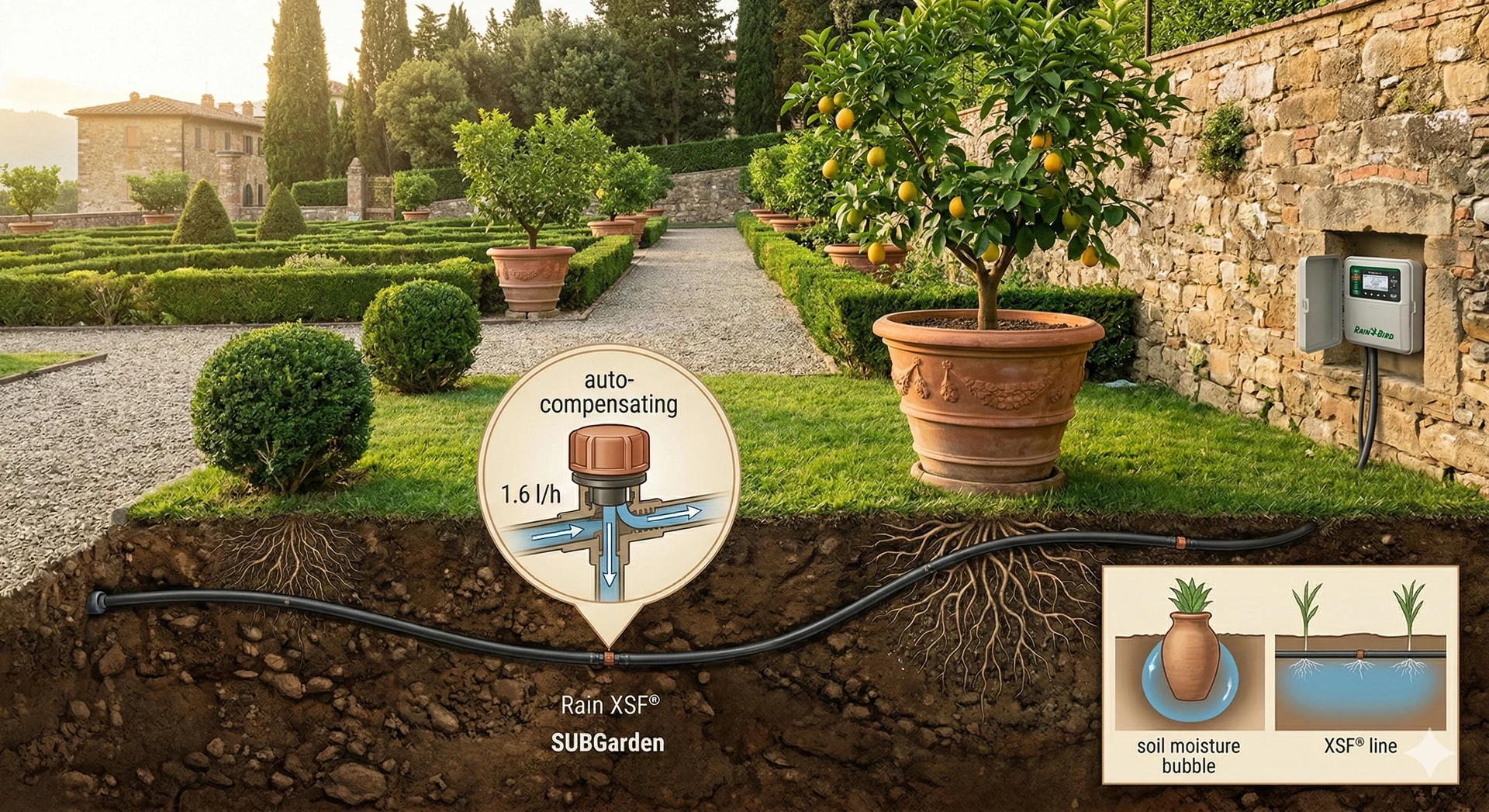
The driplines sit a few centimetres deep, in parallel rows. Each emitter releases a little water at a time and the soil spreads it by itself, through capillary action.
The lawn
The surface stays dry: no puddles, no spray on the furniture, you can walk on it straight away.
The roots
They get the water directly, with no evaporation and no runoff.
The dripline
Rain Bird XFS, pressure-compensating from 0.4 to 3.6 atm: every emitter delivers 1.6 l/h, at the start of the line as at the end.
The water
It spreads slowly and evenly by capillary action and rises towards the roots. Efficiency is above 90%.
Data sheet
The Rain Bird XFS dripline in figures
The figures that matter, from the product data sheet and our installation layout.
- Flow per emitter
- 1.6 l/h
- Low flow and low pressure: no large pumps or storage tanks needed.
- Pressure-compensating range
- 0.4–3.6 atm
- Across this whole range every emitter delivers the same amount of water.
- Installation grid
- 300 × 330 mm
- Parallel lines, 300 mm from one line to the next.
- Water efficiency
- >90%
- Water does not evaporate or run off the surface.
- Water saving
- 50–70%
- Compared with sprinkler irrigation.
What the system includes
- Emitters that self-flush at every cycle
- Root intrusion protection for the emitters (Copper Shield)
- Air relief valves on every zone
- Filter and pressure regulator after the valve
- Pipe flushing without activating the emitters
- Fertigation straight to the roots
Installation
Designed for existing gardens
The installation method is patented: the lines go under the lawn without invasive digging. The turf is not removed, roots and fixed furniture stay where they are, and once the job is done the system cannot be seen.
The same network can be used for fertigation: fertiliser reaches the roots and does not sit on the lawn where people walk. Maintenance is done from the zone valves, without touching the garden.
An ancient principle
Water underground, as it has always been
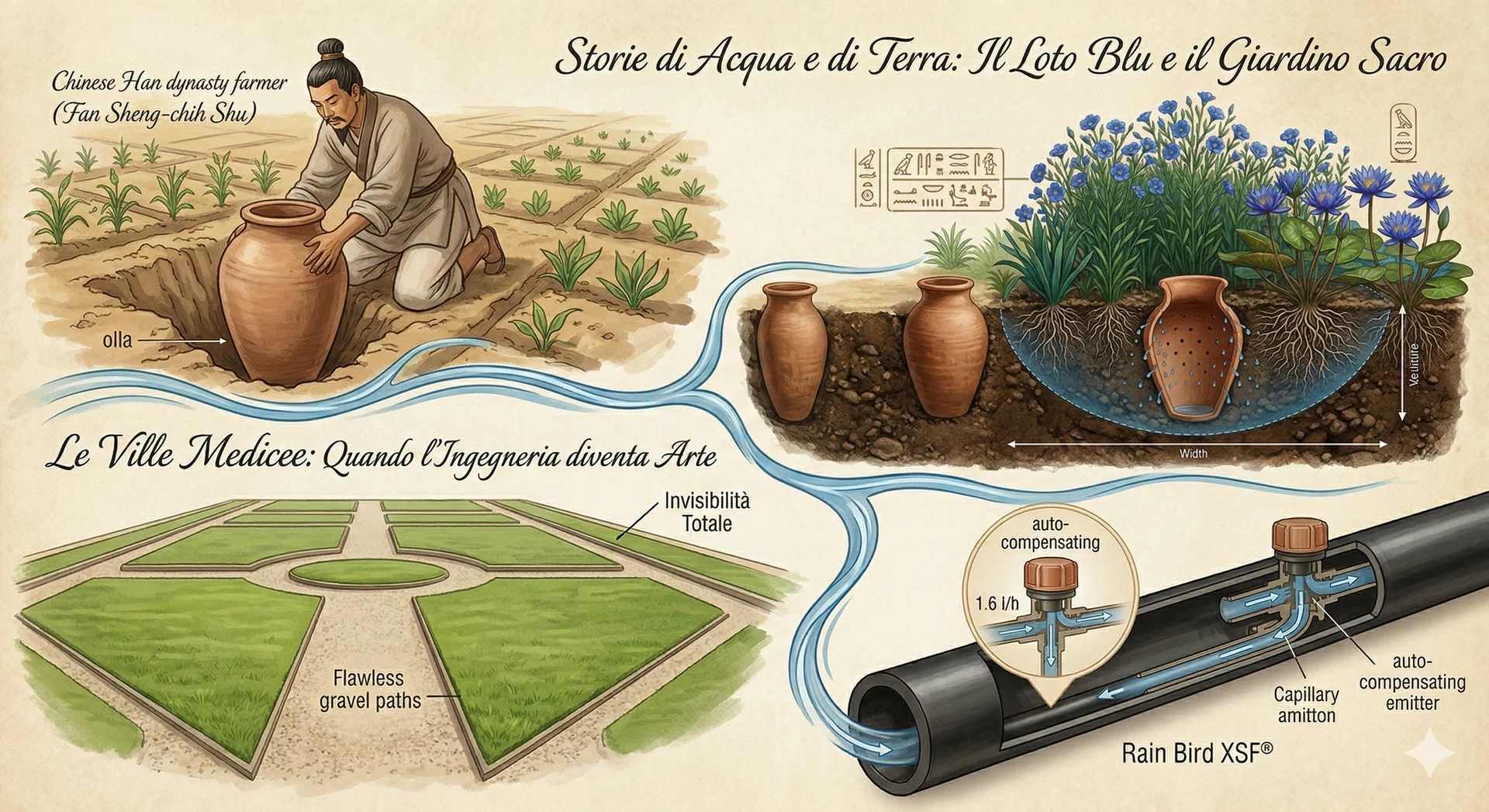
From terracotta to polymer: the principle is the same, the technology has changed. Where the ancient Egyptians used the porosity of clay, we use patented self-compensating emitters to ensure every root receives the right amount of moisture, drop by drop, with no evaporation and no waste.
Subsurface irrigation compared
| Method | SUBGarden | Ancient ollas | Sprinkler irrigation |
|---|---|---|---|
| Maintenance | Minimal, decades without clogging | Replacement every 3-4 seasons (salts/roots) | High (broken heads, clogging) |
| Uniformity | Very high (>90%), self-compensating | Variable, depends on slope | Medium-low (wind, evaporation) |
| Water efficiency | Very high (>90%) | High, but manual refilling | 60-75% |
| Surface impact | Zero, fully buried | Visible opening at ground level | Visible sprinklers and pipes |
In short
The system in three panels
The panels made for SUBGarden: tap one to see it large and read it.
How we work
From site visit to handover, in five steps
Step 1: Technical site visit
Accurate analysis of the garden's status and any existing system to identify the best conversion opportunities.
Step 2: Tailored design
Development of a precision grid pattern and detailed cost analysis, optimizing every supply line.
Step 3: Clear quote and timeline
Presentation of the technical project, clear quote, and definition of the works schedule.
Step 4: Installation with the patented method
Fast, clean, and absolutely non-invasive execution. The lawn and roots suffer no damage, the system is invisible from day one.
Step 5: Support and warranty
Certified handover with one year of free support and possibility of unlimited warranty through seasonal maintenance.